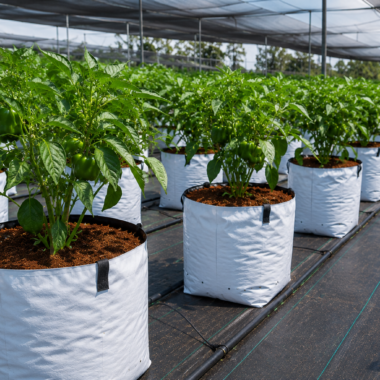
Blueberries grow well in coir because it drains freely, holds an even amount of moisture and starts with very few nutrients, which lets the grower control pH and feeding through the irrigation. Most commercial substrate blueberries in Australia are grown in pots or grow bags filled with a coir pith and chip blend, fed by drip fertigation and often grown under tunnels or netting.
This guide covers why growers move blueberries out of the soil and into coir, what to look for in a substrate and container, how to manage pH and feeding, and how raspberries and blackberries compare. It is general guidance. Every farm, variety and water source is different, so check decisions with your agronomist.
Why grow blueberries in substrate instead of soil?
Blueberries need an acidic, well-aerated root zone. Many Australian soils are too heavy, too alkaline or too variable to provide that consistently without major amendment. Growing in containers filled with a soilless substrate gives you:
- Control over the root zone. pH, nutrition and moisture are managed through the irrigation water rather than corrected in the soil.
- Drainage and air. A free-draining substrate reduces the waterlogging that blueberry roots tolerate poorly.
- Flexibility. Plants can be established on sites where the soil would otherwise rule blueberries out.
- Uniformity. Every plant sits in the same medium, which makes irrigation and feeding easier to standardise.
The trade-off is that container plants have a small root volume and little buffer, so irrigation and fertigation need to be reliable.
What makes coir suitable for blueberries?
Coir (cocopeat) is made from coconut husk. It is popular for berry production because it:
- holds water well while still draining freely, especially when pith is blended with chips;
- keeps its structure for a long time, which matters for a perennial crop that stays in the same container for years;
- re-wets easily compared with some peat-based media once it has dried;
- has a low nutrient starting point, so feeding is set by the grower.
Pith, chips or a blend?
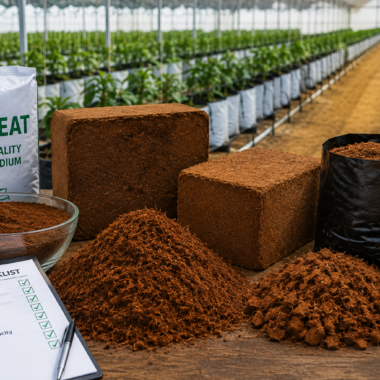
Coir pith is the fine, peat-like fraction and holds the most water. Coir chips are larger husk pieces that create air space and drainage. Blends such as a 70/30 mix balance the two. Blueberries generally benefit from a blend with a good share of chips for air, but the right ratio depends on your climate, irrigation frequency and container size. Oz Bunji supplies 5kg cocopeat blocks in 100% pith, 100% chip and a 70/30 pith-chip mix, and the Coco Grow – Berry Grow coir medium developed for berry cultivation. Compare mixes in coir pith vs coir chips.
Do you need to wash or buffer coir before planting blueberries?
Raw coir can contain sodium and potassium from its coastal origin. Commercial growers normally use coir that has been washed and buffered (usually with a calcium-based solution) so those salts don’t compete with the nutrients you apply. Before planting, check the EC (salinity) of the drainage water from a few containers. If it is high, flush with good-quality water before feeding. Ask your supplier whether a product has been washed or buffered, and how.
How do you manage pH for blueberries in coir?
Blueberries prefer an acidic root zone, generally around pH 4.5 to 5.5. Coir usually sits higher than that, so in substrate systems pH is managed mainly through the nutrient solution, for example by acidifying the irrigation water and using ammonium-based nitrogen sources. Monitor the pH and EC of both the dripper water and the drainage regularly. The drainage tells you what is actually happening around the roots.
What size container or grow bag do blueberries need?
Commercial programs commonly start young plants in smaller containers and move them into larger ones, often in the range of 25 to 35 litres, as the bushes mature. Wider containers are generally preferred over tall, narrow ones because blueberry roots are shallow and spread sideways. Whatever you use must drain freely and resist breaking down in the sun. Oz Bunji’s grow bags and grow slabs include open-top grow bags in several sizes and the Coco Grow range.
Irrigation and feeding
- Little and often. Container plants dry out faster than field plants, so frequent short drip cycles are typical, especially in summer.
- Aim for some drainage. A small percentage of run-off each day stops salts building up in the substrate.
- Measure, don’t guess. Track the volume, EC and pH of the drainage from representative containers.
- Water quality matters. High-bicarbonate water pushes pH up and may need acid treatment.
Protecting the crop: tunnels, film and netting
Many substrate blueberry farms are also grown under protection to reduce rain and hail damage, protect fruit from birds and extend the harvest window. Typical inputs include berry and greenhouse film for tunnels, bird netting, knitted shadecloth and weedmat under the rows. The NSW Mid North Coast around Coffs Harbour is a major centre for this kind of production in Australia. For an overview of structures, see what is protected cropping?
Can raspberries and blackberries be grown in coir too?
Yes. Raspberries and blackberries are also widely grown in substrate under tunnels. They are less demanding about acidity than blueberries but share the same need for a free-draining, well-aerated medium and consistent fertigation. Long-cane and primocane systems differ in container size and trellising, so plan the support system (posts, wire and twine) alongside the substrate. Oz Bunji supplies polyester wire, growers twine and tunnel rope.
Quick checklist
- Choose a washed and buffered coir with a pith/chip ratio suited to your climate and irrigation.
- Use a free-draining container or grow bag sized for mature plants.
- Check substrate EC before planting and flush if needed.
- Manage pH through the nutrient solution, targeting an acidic root zone.
- Monitor drainage EC, pH and volume every week.
- Plan protection (film, netting, shade) and trellising before planting.
Need coir, grow bags or tunnel film for a blueberry or berry project? Contact Oz Bunji for product advice and a quote. We supply growers Australia-wide.